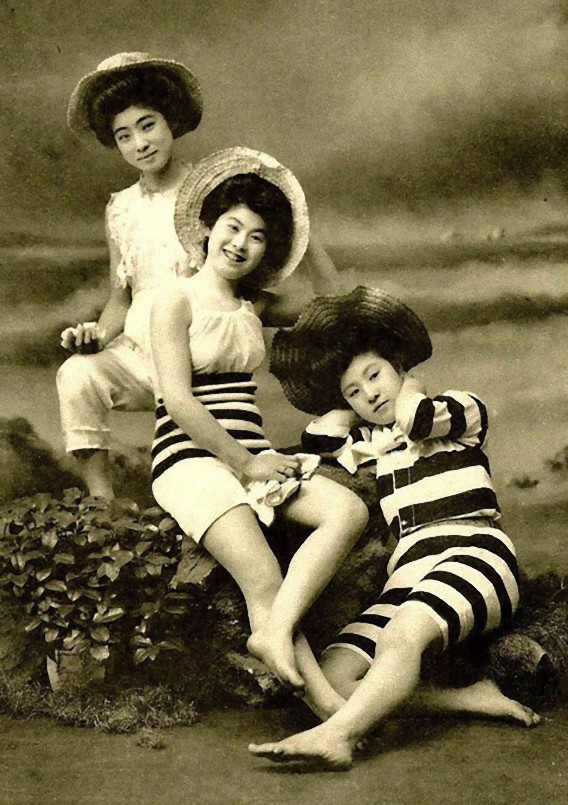
JAPANESE OLD PIN UP PHOTO
2013年4月5日金曜日
2013年2月24日日曜日
Raijū
Raijū
Raijū (雷獣,"thunder animal" or "thunder beast") is
a legendary creature from Japanese mythology.
Its body is composed of lightning and may be in the shape of a cat, fox, weasel, or wolf.
The form of a white and blue wolf (or even a wolf wrapped in lightning) is also common.
It may also fly about as a ball of lightning (in fact, the creature may be an attempt to explain the phenomenon of lightning). Its cry sounds like thunder.
Raiju is the companion of Raijin, the Shinto god of lightning. While the beast is generally calm and harmless, during thunderstorms, it becomes agitated and leaps about in trees, fields, and even buildings (trees that have been struck by lightning are said to have been scratched by Raiju's claws).
Another of Raiju's peculiar behaviors is sleeping in human navels. This prompts Raiden to shoot lightning arrows at Raiju to wake the creature up, and thus harms the person in whose belly the demon is resting. Superstitious people therefore often sleep on their stomachs during bad weather, but other legends say that Raiju will only hide in the navels of people who sleep outdoors.
2013年1月24日木曜日
Hitotsume-kozō
Hitotsume-kozō
Hitotsume-kozō are roughly "the size of ten-year-old children," but otherwise "resemble bald Buddhist monks."
Their most distinctive feature, however, is a "single, giant eye peering from the center of the face, along with a long tongue, much like a Tsukomogami.
Hitotsume-kozō are relatively harmless creatures, content to "run about frightening people or telling loud people to be quiet."
Since many people consider an encounter with a [Hitotsume-kozō] to be a bad omen ... often [they] leave bamboo baskets in front of their houses, as these are reputed to repel the creatures. A reason for this may be that, in seeing the basket's many holes, the Hitotsume-kozō will see the basket as having many eyes, and run away jealous and ashamed at only having one.
2013年1月19日土曜日
YAMANBA
Yamauba (山姥 or 山うば), Yamamba or Yamanba
are variations on the name of a yōkai found in Japanese folklore.
Description
in Classical Japanese FolkloreDepending on the text and translator, the Yamauba appears as a monstrous Crone, “her unkempt hair long and golden white ... her kimono filthy and tattered,” with cannibalistic tendencies. In one tale a mother traveling to her village is forced to give birth in a mountain hut assisted by an apparent kindly old woman, only to discover, when it is too late, that the stranger is actually Yamauba with plans to eat her newborn child. In other story the yōkai raises the orphan hero Kintarō, who goes on to became the famous warrior Sakata no Kintoki.
Yamauba is said to have a mouth at the top of her head under her hair.
In one story it is related that her only weakness is a certain flower containing her soul.
2012年11月19日月曜日
Kuchisake-onna
Kuchisake-onna
In Japanese mythology, Kuchisake-onna ("Slit-Mouthed Woman") is a woman who is mutilated by a jealous husband and returns as a malicious spirit. When rumors of alleged sightings began spreading in 1979, it spread throughout Japan and caused panic in many towns. There are even reports of schools allowing children to go home only in groups escorted by teachers for safety, and of police increasing their patrols.
According to the legend, children walking alone at night may encounter a woman wearing a surgical mask, which is not an unusual sight in Japan as people wear them to protect others from their colds or sickness. The woman will stop the child and ask, "Am I beautiful?" If the child answers no, the child is killed with a pair of scissors which the woman carries. If the child answers yes, the woman pulls away the mask, revealing that her mouth is slit from ear to ear, and asks "How about now?". If the child answers no, he/she will be cut in half. If the child answers yes, then she will slit his/her mouth like hers. It is impossible to run away from her, as she will simply reappear in front of the victim. It is said she does this because of some marital issues.
When the legend reappeared in the 1970s rumors of ways to escape also emerged. Some sources say she can also be confused by answering her question with, rather than yes or no, "You are average." Unsure of what to do, she will give a person enough time to escape while she is lost in thought. Another escape route is to tell her one has a previous engagement; she will pardon her manners and excuse herself. In some variations of the tale, she can be distracted by throwing fruit or sweets at her which she will pick up, thus giving the victim a chance to run. Another way is for the child to ask her if the child is pretty; she will get confused and leave.
登録:
投稿 (Atom)